
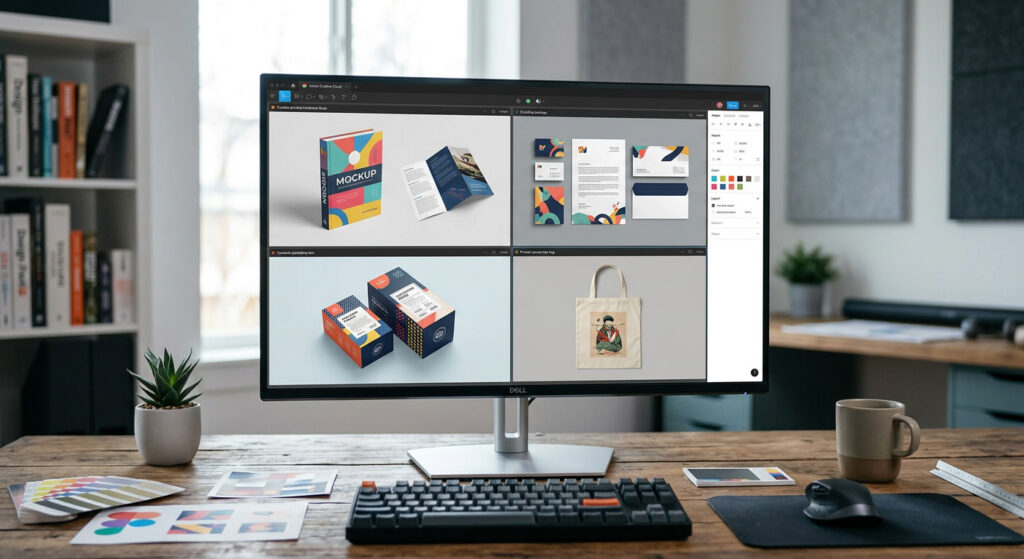
The best mockup tools can now produce images that are virtually indistinguishable from professionally photographed products, according to a 2026 industry guide on product mockup technology. That bar didn’t exist a few years ago. A digital product sample used to be a rough approximation, useful for a general sense of a design but obviously not the real thing. Today, a well-made one can close a deal before a single physical unit exists.
Client-ready promotional product samples show a design on any garment, bag, or promotional item digitally, color-accurate and delivered fast, before production ever begins. That’s the standard a distributor is actually being compared against now, not the rough mockups clients might remember from a few years back.
That shift changes the conversation with a client too. A rough mockup used to come with an implicit disclaimer, this is roughly what it’ll look like. A photorealistic virtual sample doesn’t get that same benefit of the doubt. Clients increasingly treat it as a preview of the exact finished product, which raises the bar for how accurate it actually needs to be.
What Makes Digital Product Samples Look Real?
Lighting, material texture, and shadow accuracy, the same three things a photographer would get right in a studio.
A convincing virtual sample simulates how light actually falls across a specific material, whether that’s the sheen of embroidered thread, the texture of woven fabric, or the reflective surface of a metal tumbler. Shadows have to fall the way they would physically, not as a flat drop-shadow effect. Get those three things right and a mockup reads as a photograph. Get any one of them wrong and something feels off, even to someone who couldn’t say exactly why, which is often the hardest kind of flaw to catch and fix before a client sees it.
USE CASE
SHARE OF AI-USING DISTRIBUTORS
Creative copy
45%
Proposals and RFPs
25%
Video creation
19%
Product recommendations
13%
Budget Mockup Tools Still Look Obviously Fake
Because photorealism quality varies significantly across platforms, and the gap shows up in the details.
The best tools now produce images indistinguishable from professional photography, while budget options still show telltale artificial characteristics, according to a 2026 review of mockup design tools. Unrealistic lighting, flat textures, and generic backgrounds are the usual giveaways. None of those flaws are obvious in isolation, but together they create an image that reads as “computer-generated” even to a client who isn’t looking for it specifically.
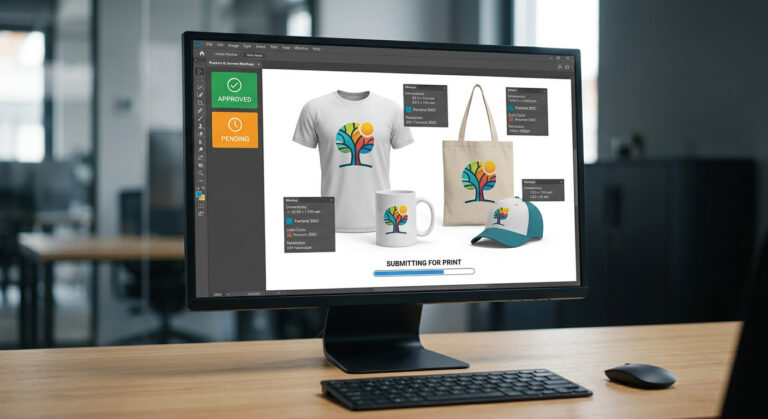
What decoration-specific details does a good virtual sample actually account for?
The same things a decoration partner has to get right in physical production, just modeled digitally first.
- Imprint area: whether the design actually fits the usable decoration space on that specific product, not just a flat rectangle overlaid on a photo.
- Imprint method: how a design should look different when it’s stitched versus printed versus engraved, since each method renders color and detail differently.
- Positive and negative spacing: whether fine details in a logo will actually hold up at the size and method being simulated, or blur together.
- Color accuracy: matching the actual thread, ink, or material color the finished product will use, not just a close approximation.
A mockup that skips these details might look fine at a glance, but it sets an expectation that the physical product then has to match exactly, or the client notices the gap immediately once the real item arrives.

Speed
A prospect goes from a name on a lead list to a full picture, brand identity included, in the time it takes to open a browser tab.

Relevance
The first conversation starts with the client's actual products, audience, and brand, not a generic pitch.

Rep time
The working hours that used to go into manual prospect research now go into preparing what to actually say.
A Flat Mockup and a True Virtual Sample Are Not the Same Thing
A flat mockup overlays a design onto a stock photo. A true virtual sample models how the design actually behaves on that specific product.
The fastest, cheapest way to show a design on a product is to paste a flat image onto an existing photo and call it a mockup. That approach ignores curvature, fabric drape, material sheen, and how a decoration method actually renders on that surface. A true virtual sample accounts for all of it, which is why it takes real production knowledge to build one well, not just image editing software. The two can look similar from a distance, and very different up close, which is exactly where a client’s trust either holds or breaks.
Why does the product’s own material properties matter so much to the final render?
Because the same design looks completely different depending on what it’s actually printed or stitched onto.
A logo that reads crisp and bright on smooth ceramic will look muted and slightly diffused on woven cotton, because the material itself absorbs and reflects light differently. A virtual sample that ignores those material properties and treats every surface the same ends up looking generic, technically present but not quite convincing. Accounting for the specific material, its texture, sheen, and how it holds ink or thread, is what separates a mockup that looks like a template from one that looks like the actual product.
When Digital Replaces Promotional Product Samples
It falls short only in a small number of edge cases.
A photorealistic virtual sample handles color, placement, and general appearance well enough to replace a physical sample for the vast majority of orders. Where it still falls short is texture a client needs to physically feel, like fabric weight or a specific finish on a hard good, and highly unusual materials the rendering process hasn’t been calibrated for yet. For everything else, a strong virtual sample gets a design approved faster than waiting on a physical proof to ship, get reviewed, and ship back with notes.
Fun fact: In adjacent industries built around physical prototyping, virtual sampling has cut physical sample production by as much as 80 to 85%, according to 2026 digital fashion sampling research. Promotional merchandise is following the same trajectory, for the same reason: a convincing digital sample removes the need to produce a physical one just to show a client what something will look like.
How fast can a client actually see an accurate mockup?
Standard turnaround runs around 24 hours, with rush options for tighter timelines.
One promotional products supplier’s case study recorded a 99%-plus proof turnaround within 24 hours, alongside 99.82% order accuracy on the finished orders that followed. Speed and accuracy aren’t separate wins there, they’re connected. A fast proof only helps if it’s also correct, and an accurate proof that takes a week to arrive loses the deal to whoever showed up faster with something just as convincing.
Check Four Things Before Approving a Virtual Sample
None of them take long to confirm, but skipping them is where most mismatches start.
- Confirm the color shown matches an actual color reference, not just what looks right on a screen that may not be calibrated.
- Check that the imprint size and placement reflect the real usable area on that specific product, not an idealized flat version.
- Ask which decoration method the mockup is simulating, since a design can look different across print, embroidery, and engraving.
- Request the mockup at the actual size the item will be produced at, not just a large, easy-to-see version that hides small-scale problems.
A partner who can answer all four confidently, with specifics, is one who’s actually built the process to back up a photorealistic mockup, not just generate an attractive image.
What happens when a virtual sample doesn’t match the finished product?
The client’s trust takes the hit, not just the specific order.
A mismatch between an approved virtual sample and the physical product that ships is one of the fastest ways to damage a client relationship, because it undermines the entire point of showing a sample in the first place. If the sample can’t be trusted, every future proof gets re-litigated the hard way, with more back-and-forth and more skepticism, even on straightforward orders. Getting the virtual sample right the first time isn’t just about winning one deal. It’s what keeps every future sample from that client getting the benefit of the doubt.
Frequently Asked Questions
What makes a virtual sample look realistic instead of obviously computer-generated?
Accurate lighting, true-to-material texture, and physically correct shadows. Get those three right and a mockup reads as a photograph rather than a rendering, even under close inspection.
How long does it take to get an accurate virtual sample?
Standard turnaround runs around 24 hours, with rush options available for tighter deadlines, without sacrificing color accuracy or decoration-specific detail in the process.
Does a realistic virtual sample actually reduce mistakes in the finished order?
It can. Proof accuracy and order accuracy tend to move together, since a mockup that correctly represents color, placement, and decoration method gives production a clear, correct target to match against.
Sources: Rewarx, “Print on Demand Mockup Guide: Etsy, Shopify, Amazon POD 2026” (2026); Bettermockups, “Mockup Design Tips 2026 to Boost Tech Accessory Sales” (March 2026); Style3D, “What Are 2026 Digital Fashion Sampling Trends?” (February 2026, physical sample reduction figures); Idea Custom Solutions Blog Playbook, approved proof point library (virtual samples service line description; promotional products supplier case study, proof turnaround and order accuracy).