
Mugs and water bottles both rank among the promotional products people actually want, alongside T-shirts, hoodies, pens, and tote bags, according to Vistaprint’s 2026 promotional product trends report. Promotional drinkware is one of the categories people genuinely keep and use, which means the decoration on it has to survive more than a single unboxing photo. It has to survive a dishwasher, a gym bag, and daily use for months.
Not every decoration method is built for that. Some sit on the surface and wear down with heat and friction. Others become part of the material itself and barely change at all. Knowing the difference before choosing a drinkware design method is the difference between a mug that still looks new after 100 washes and one that’s peeling by wash twenty.
That distinction matters just as much for a small custom order as it does for a large one. A single mismatched material and method combination on a 500-unit order is a much bigger problem than the same mistake on a sample of five.
Four Ways to Decorate Promotional Drinkware
Laser engraving, screen printing, digital or UV printing, and sublimation, each with a different relationship to the surface.
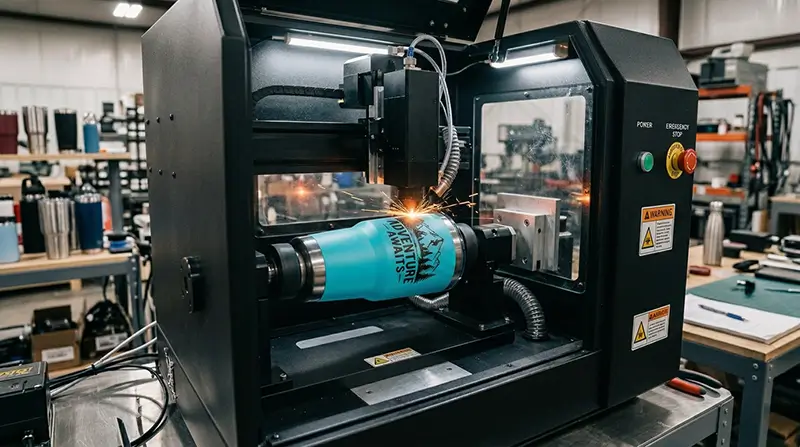
- Laser engraving: a laser physically etches the design into the material itself, most commonly stainless steel or anodized aluminum.
- Screen printing: ink is applied through a stencil in layers, then cured, sitting on top of the surface rather than inside it.
- Digital or UV printing: a printer applies full-color, photo-realistic ink directly to the item, cured instantly under UV light.
- Sublimation: dye is heat-transferred into a poly-coated surface, where it bonds with the coating instead of sitting on top of it.
The core difference across all four comes down to one question: does the decoration sit on the surface, or does it become part of it. That answer predicts almost everything about how well it survives repeated washing.
Laser Engraving Holds Up Close to Permanently
The design is physically part of the material, not a coating sitting on top of it.
Because engraving removes or alters the material itself, there’s nothing sitting on the surface to crack, fade, or peel. It’s dishwasher safe indefinitely on the metals it works with. The tradeoff is color: engraving typically reveals the base material underneath, so it’s usually a single tone rather than a full-color design, and it only works on materials that can actually be etched, mainly metal.
How does screen printing actually hold up over time?
Reasonably well if hand washed, less well in a dishwasher over repeated cycles.
Screen printing is cost-efficient at volume and works well for designs with a few solid colors. But because the ink sits on top of the surface rather than inside it, repeated exposure to dishwasher heat and detergent can cause it to crack or peel at the edges over time. It’s a strong choice for drinkware that’s expected to be hand washed, less reliable for anything going through a dishwasher on a weekly basis.
Digital and UV Printing Hold Up Well, With a Surface-Level Wear Risk
It can reproduce full-color, photo-realistic designs that other methods can’t.
UV printing can reproduce full-color, photo-realistic designs that other methods can’t, which makes it the choice when a design has gradients or complex color work. But like screen printing, the ink still sits on the surface. Without a protective topcoat, it faces the same long-term wear risk from dishwasher cycles and abrasive handling. A topcoat extends its life significantly, but it’s an added step, not a given.
How does sublimation actually hold up over time?
Very well, because the dye becomes part of the coating rather than sitting on it.
Sublimation only works on items with a poly-coating, usually a light-colored one, since the dye needs a coating to bond with and shows up best on lighter surfaces. Once applied, the color is embedded in that coating rather than layered on top, so it doesn’t crack, peel, or fade the way surface-level inks can. The tradeoff is the material requirement itself: sublimation isn’t an option on plain stainless steel or uncoated ceramic.
The Four Methods Compared Side by Side
Each one trades off differently between durability, color range, and material requirements.
| Method | Surface Relationship | Color Range | Typical Material |
|---|---|---|---|
| Laser engraving | Etched into material | Single-tone | Metal |
| Screen printing | Sits on surface | Few solid colors | Ceramic, metal, plastic |
| Digital or UV printing | Sits on surface | Full color | Most materials |
| Sublimation | Embedded in coating | Full color | Poly-coated, light-colored items |
Laid out side by side, the pattern is clear: the two methods that actually alter or bond with the material, laser engraving and sublimation, are also the two with the least long-term wear risk. The two that sit on top of the surface, screen printing and digital printing, trade some of that durability for a wider color range and broader material compatibility.
Does the decoration method affect cost?
Yes, in different ways depending on order size.
Screen printing has setup costs tied to each color in the design, but becomes very cost-efficient at high volume once that setup is done. Laser engraving has minimal per-unit variation but requires compatible equipment and works best at a steady, moderate volume. Digital and UV printing carry a higher per-unit cost but no setup cost tied to color count, which makes them a better fit for smaller runs or designs that change often. Sublimation sits in between, efficient at moderate to high volume but tied to the cost of poly-coated blanks. None of the four is universally cheaper, the right choice depends on the order size and how often the design changes.
Fun fact: Water bottles and mugs both appear on Vistaprint’s 2026 list of the promotional products people say they most want to receive, right alongside T-shirts and hoodies. Drinkware isn’t a throwaway category. It’s one people actually expect to use for months, which is exactly why the decoration method matters more here than on a single-use giveaway.
Drinkware Design: Choosing by Material, Design, and Use
There’s rarely one universally correct answer for every order.
There’s rarely one universally correct answer. The right method is the one that matches the material on hand and how the finished piece will actually be used, not just which one looks best in a sample photo.
Metal tumbler or bottle, single-tone design, dishwasher use expected: laser engraving.
Ceramic or metal mug, a few solid colors, budget-conscious, hand wash expected: screen printing.
Any material, full-color or photo-realistic design, willing to add a protective topcoat: digital or UV printing.
Light-colored, poly-coated mug or bottle, full-color design, dishwasher use expected: sublimation.
What should a distributor confirm with a client before choosing a decoration method?
Four details, before any method gets locked in.
- The exact material and coating of the item, not just the color or shape.
- Whether the item is expected to go through a dishwasher regularly or mostly get hand washed.
- How many colors the design actually needs, and whether it includes gradients or photo-realistic detail.
- The order volume and budget, since some methods are far more cost-efficient at scale than others.
Getting those four answers before production starts prevents the most common drinkware complaint: a design that looked great on delivery and started peeling a few weeks later.
The Most Common Mistake Is Picking Based on a Sample Photo Alone
That comparison says nothing about which one actually survives daily use.
A full-color UV-printed design photographs beautifully next to a laser-engraved one, but that comparison doesn’t say anything about which one survives six months of daily dishwasher cycles. The method that looks best in a mockup and the method that holds up longest in someone’s kitchen aren’t always the same choice. Asking about expected use before choosing a method avoids a reorder down the line, and a reorder almost always costs more than getting the first one right.
How does artwork prepress fit into choosing a decoration method?
Every method above needs the same source artwork prepared differently before it ever reaches production.
A design headed for laser engraving needs a vector file optimized for a single-tone etch, with no color information the laser can’t use. The same design headed for screen printing needs its colors separated into individual spot channels, one per screen. Sent to digital or UV printing, it needs a full CMYK color profile instead of the RGB it was likely designed in, or the printed colors won’t match what was approved on screen. Sublimation needs its own profile matched to how that particular poly-coating reproduces dye. That prepress step, converting one piece of source art into whatever format each specific method actually requires, is what Idea Custom’s artwork management and prepress service handles before a design ever reaches a laser, a screen, or a heat press. Choosing the right decoration method is only half the decision. Prepping the artwork correctly for that specific method is the other half, and it’s usually the half that determines whether the first production run comes out right.
Frequently Asked Questions
Which drinkware decoration method lasts the longest?
Laser engraving and sublimation typically last the longest, since both become part of the material or coating itself rather than sitting on top of it as a separate layer that can wear away.
Is screen-printed drinkware dishwasher safe?
Not reliably over the long term. Hand washing is recommended, since repeated dishwasher heat and detergent exposure can cause the ink to crack or peel at the edges over dozens of cycles.
Can full-color designs be laser engraved?
No. Laser engraving etches the material itself and typically produces a single-tone result, so full-color or gradient designs need digital printing or sublimation instead, depending on the item’s material.
Sources: Vistaprint, 2026 promotional product trends report (consumer product preference ranking); Idea Custom Solutions Blog Playbook, service line description (Artwork Management & Prepress); general decoration method specifications and durability characteristics, standard promotional products production practices.